View Factor Orientation (or View factor or shape factor) plays an important role in radiation heat transfer. View factor is defined as, "fraction of radiation leaving surface 'i' and strike 'j' ". Summation Rule (View Factor) If there is are similar surfaces 'i' and 'j' , then: Blackbody Radiation Exchange Radiation Exchange between Opaque, Diffuse, Gray surfaces in an Enclosure 1. Opaque 2. Surfaces 3. Two surface enclosure Radiation Shield It is used to protect surfaces from radiation act like a reflective surface. References: Material from Class Lectures + Book named Fundamentals of Heat and Mass Transfer by Theodore L. Bergman + My knowledge. Photoshoped pics are developed. Some pics and GIF from Google. Videos from YouTube ( Engineering Sights ).
Get link
Facebook
X
Pinterest
Email
Other Apps
Vapour and Combined Power Cycle
Get link
Facebook
X
Pinterest
Email
Other Apps
-
Rankine Cycle
Rankine cycle is an ideal cycle for Vapour Power Cycles and is normally used for Electricity Generation.
The Rankine cycle consist of following steps:
1 ↝ 2 : Isentropic Compression in Pump.
2 ↝ 3 : Constant Pressure Heat Addition in Boiler.
3 ↝ 4 : IsentropicExpansion in Turbine.
4 ↝ 1 : Constant Pressure Heat Rejection in Condenser.
Energy Balance:
Since, all the devices which Rankine Cycle posses are steady flow devices, so the energy balance for Rankine cycle is:
》For Pump ( q = 0 ):
》For Boiler ( w = 0 ):
》For Turbine ( q = 0 ):
》For condenser ( w = 0 ):
The thermal efficiency of Rankine Cycle is:
How can we Increase the Efficiency of A Rankine Cycle:
The efficiency of a Rankine cycle can be increased:
Increasing the avg. temperate at which heat is added
Decreasing the avg. Temperature at which heat is rejected.
The above two objectives can be achieved by following three methods:
1. By Superheating the steam in the Boiler:
By superheating the fluid, the area W2 is added, so increase its efficiency.
2. By Increasing Boiler Pressure:
By increasing the boiler pressure, the area W2 is added, so increase its efficiency.
3. By Decreasing the Condenser Pressure:
By Decreasing the condenser pressure, the area W2 is added, so increase its efficiency.
Boilers
A fuel-burning apparatus or container used for heating water is called Boiler.
Types of Boilers:
There are many types of boilers but commonly used boilers in Industries are:
1. Fire-Tube Boilers:
In fire-tube boiler, flue gases or combustion gases are inside the tubes and water will be in the shell. They are big in size, require much time for heat transfer, require greater maintanences and are suitable for low pressure industrial applications.
2. Water-Tube Boilers:
In water-tube boiler, water is inside the tubes and hot gases will be in the shell. They are small in size, require not much time for heat transfer, require less maintanences and are suitable for high pressure industrial applications.
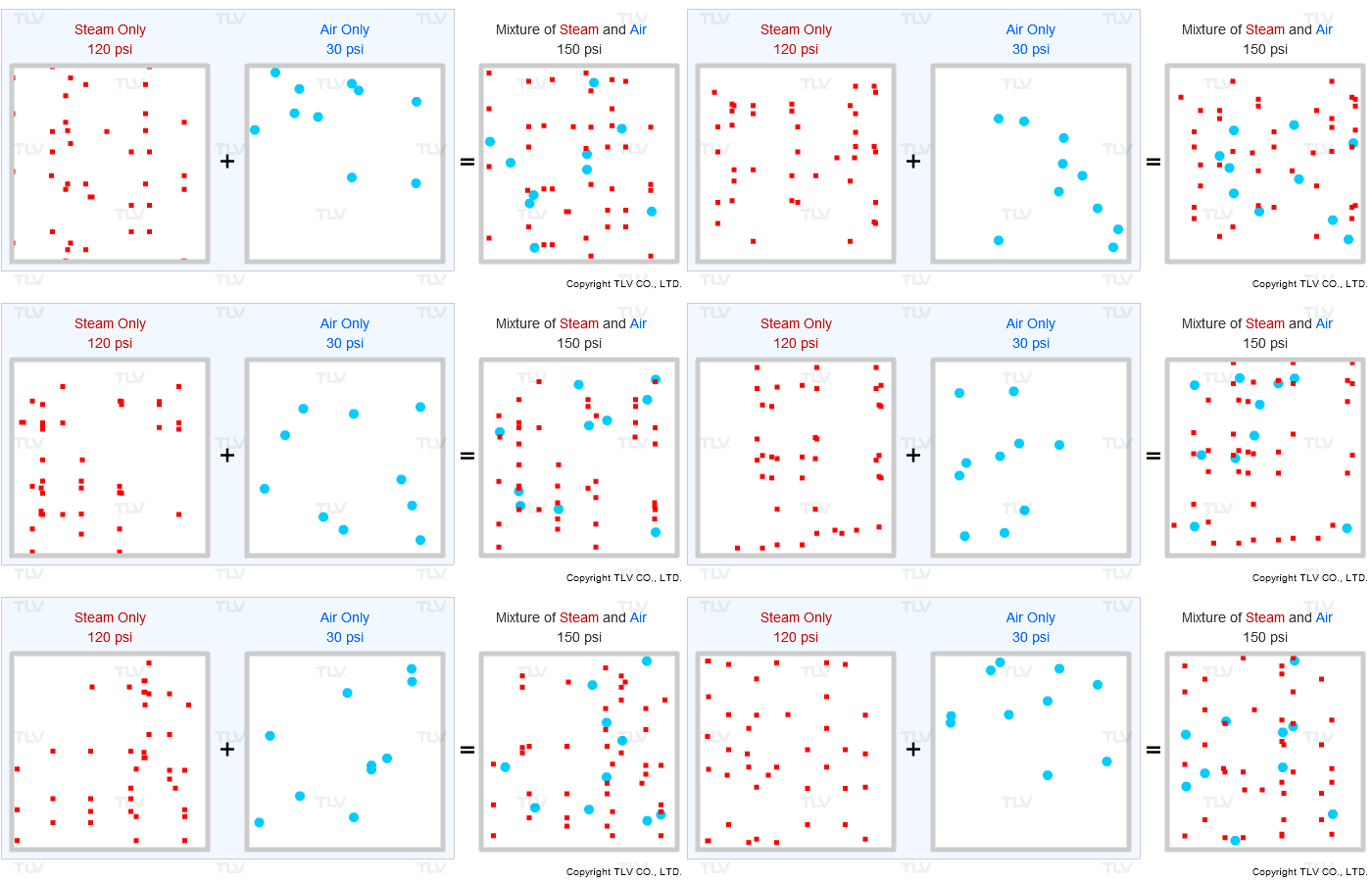
Dalton's Law of Partial Pressure:
It states that:
Total pressure of a cylinder is equal to the sum of pressure of individual gases.
Note: If anyone wants me to publish a post on your topic related to mechanical engineering, Ielts, robotics, Web designing, etc, I am glad to see your interest and I can entertain you as well.
Great work dude but can you can do better by involving GIF. You have added some of them but that's not enough. But all over. you have done a great job. The last thing please you should let us know the way of studying abroad, yeah right i am talking about Ielts.
Mechanical Injection System: Used to inject fuel into the combustion chamber. Fuel speed > air speed at delivery point to atomize fuel. Amount of fuel delivered into the air stream going into the engine is controlled by pump which forces the fuel under pressure. A device used to initiate and control the combustion process is called Mechanical Injection System. Functional Requirements of Injection System: Metering of Fuel: Used to control fuel to meet speed and load requirements of the engine. Injection Timing: Have proper injection timing to obtain max. power, fuel economy and proper burning. It is done by Camshaft or Push rod (Rocker Arm) Mechanism . Proper Control of Injection Rate: To get desired heat release pattern during combustion. Proper Atomization of Fuel: Proper making of droplets to make best Air/Fuel mixture. Proper Spray Pattern: Distribution of droplets to ensure rapid mixing of fuel & air. Uniform Distribut...
ENGINEERING SURVEY Surveying is the science, art and technology of determine the relative positions of points above, on or beneath the Earth's surface so as to construct a map, plan or description. TYPES OF SURVEY : There are many types of survey but we discuss some of them. 1. Plane & Geodatic Survey : Ordinary field and topographical surveying in which the Curvature of Earth's surface is disregarded is called Plane Survey. It is performed when the area is smaller than 250sq.km. A survey of a large land area in which corrections are made for the Curvature of Earth's surface is called Geodatic survey. Why Geodatic Survey is important? Earth's surface is not flat, it is sphere. So all the calculations which were made by considering the Earth's surface flat are incorrect. So a new type of survey came into play which made calculations on the basis of geodatic condition of Earth's surface. 2. Topographic Survey : Topographic surv...
Projection: The term Projection is defined as: Presentation of an image or an object on a surface. The principles used to graphically represent 3-D objects and structures on 2-D media and it based on two variables: Line of Sight. Plane of Projection. Line of Sight & Plane of Projection: Line of sight is divided into 2 types: Parallel Projection Converging Projection & A plane of projection is an imaginary flat plane upon which the image created by the lines of sight is projected. Orthographic Projection: When the projectors are parallel to each other and perpendicular to the plane of projection. The lines pf sight of the observer create a view on the screen. The screen is referred to as the Plane of Projection (POP). The lines of sight are called Projection lines or projectors. Rules of Orthographic Projection: Edges that are parallel to a plane of projection appear as lines. Edges that are incl...




Great work dude but can you can do better by involving GIF. You have added some of them but that's not enough. But all over. you have done a great job.
ReplyDeleteThe last thing please you should let us know the way of studying abroad, yeah right i am talking about Ielts.
Great use of GIF but of you want to make your blog more attractive you can contact any time you want to������
ReplyDelete