Posts

Showing posts with the label Fluid Mechanics-I

Radiation Heat Transfer

Image
View Factor Orientation (or View factor or shape factor) plays an important role in radiation heat transfer. View factor is defined as, "fraction of radiation leaving surface 'i' and strike 'j' ". Summation Rule (View Factor) If there is are similar surfaces 'i' and 'j' , then: Blackbody Radiation Exchange Radiation Exchange between Opaque, Diffuse, Gray surfaces in an Enclosure 1. Opaque 2. Surfaces 3. Two surface enclosure Radiation Shield It is used to protect surfaces from radiation act like a reflective surface. References: Material from Class Lectures + Book named Fundamentals of Heat and Mass Transfer by Theodore L. Bergman + My knowledge.  Photoshoped pics  are developed.  Some pics and GIF from Google.   Videos from YouTube ( Engineering Sights ).
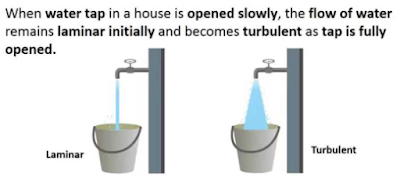
Viscous Flow In Pipes

Image
Reynolds Number: Reynolds Number is the ratio of Inertial forces to the Viscous forces. By knowing this number, one can describe the flow whether the flow is laminar, turbulent or transitional flow. There are three possibilities of the range of Reynolds Number: If Reynolds number < 2100 or 2300   ⟺  Laminar Flow If Reynolds number > 4000   ⟺  Turbulent Flow If 2300 < Reynolds number < 4000   ⟺  Transitional Flow In case of different shapes other than circle, the formula for Reynolds Number remain the same however diameter involves in the formula become Hydraulic Diameter which is given by: For pipe: Critical Reynolds Number  ⟾  The Reynolds number at which the flow becomes turbulent Re cr For different shapes, the hydraulic diameters are given by: Completely Filled Flow In Closed Channel: If pipe is is considered to filled completely with closed channel, then following are the conditions which...

Dimensional Analysis, Similitude & Modeling

Image
Dimensional Analysis & Similarity: The main purposes of dimensional analysis (To test before making any prototype) are: To generate non-dimensional parameters that help in the design of experiment and in the reporting of experimental results. To obtain scaling laws so that prototype performance can be predicted from model performance. To predicts trends in the relation between parameters. Principle Of Similarity: There are three principles of similarity which are described below: 1. Geometric Similarity: The model must be of the same shape as that of prototype but may be scaled by some constant scale factor. Just keep in mind only dimensions are to be scaled not angle. 2. Kinematic Similarity: The velocity at any point in the model flow must be proportional to the velocity at the corresponding point in the prototype. 3. Dynamic Similarity: It is achieved when all forces in the model flow scale by a constant factor to the corresponding forces in the prot...

Fluid Dynamics

Image
Fluid Dynamics: It deals with the study of fluid(invicid) particles when they are in motion. It involves concepts of force, acceleration and newton's 2nd law of motion. This means, it is the study of fluid flow. There are two types of flow, namely: Steady Flow   ⟼  If the fluid velocity at a point is not a function of time like V = f(x, y, z). Unsteady Flow   ⟼  If the fluid velocity changes with time like V = f(x, y, z, t).  Approaches To Find Fluid Movement: There are two types of approach which can tells the behavior and movement of fluid particles which are described below: 1. Eulerian Approach: Eulerian approach depends upon the fixed space that means it depends on flow domain or control volume. If we take velocity field, then Eulerian approach is represented as V = f(x, y, z, t) . 2. Lagrangian Approach: Lagrangian approach depends upon individual particles (for e.g balling styles & its projectile). If we take velocity fi...