View Factor Orientation (or View factor or shape factor) plays an important role in radiation heat transfer. View factor is defined as, "fraction of radiation leaving surface 'i' and strike 'j' ". Summation Rule (View Factor) If there is are similar surfaces 'i' and 'j' , then: Blackbody Radiation Exchange Radiation Exchange between Opaque, Diffuse, Gray surfaces in an Enclosure 1. Opaque 2. Surfaces 3. Two surface enclosure Radiation Shield It is used to protect surfaces from radiation act like a reflective surface. References: Material from Class Lectures + Book named Fundamentals of Heat and Mass Transfer by Theodore L. Bergman + My knowledge. Photoshoped pics are developed. Some pics and GIF from Google. Videos from YouTube ( Engineering Sights ).
Get link
Facebook
X
Pinterest
Email
Other Apps
Boiler Safety and Test
Get link
Facebook
X
Pinterest
Email
Other Apps
-
Boiler Hydro Test
Boiler hydro test is used to ensure all the welding joints, pipe bents and all headers are water leak proof.
It is done at pressure of 1.5 times of design pressure.
E.g.: If design pressure of boiler is 50 bar, then the hydraulic test pressure will be 75 bar.
Pre-Checklist Hydro Test
Following are the pre-checklist for the hydro test of Boiler:
All erection work should be completed.
Confirm that no foreign material left in the boiler.
Confirm the drum manhole is closed with proper gasket.
Confirm all the drain system ready for operation.
All safety valve should be gagged.
The range of the pressure should be 2 times of the maximum test pressure but not less than test pressure.
The pressure gage should be pre-calibrated before test.
The test pump should have capacity of more than test pressure.
Minimum quantity of demineralized water should be available equivalent to the boiler capacity.
Ensure condensate and Feedwater chemistry parameters to strictly adhere to the required standard.
PH value should be in range of 8 - 9.
The water temperature should not less than 21.1 ℃.
Isolate all pressure and temperature gages except some pressure gages for hydraulic pressure measurements.
Start the boiler filling with the filling pump through the drain header (or filling time).
Close all vents sequentially after water coming from the vents.
Start the hydro test pump ensure all vents closed and rise pressure gradually to the design pressure and then the pressure to be raised up to the test pressure. E.g.: Design pressure = 200 bar, Test pressure = 300 bar).
Hold the pressure raising at 50 bar and 100 bar to check any valve passing and inspect leakage in pressure parts.
Once the pressure reached to the test pressure stop pressurizing and observe pressure drop if the pressure drop is very less then the test is successful.
If any defect is found, type of defect should be solved.
If the pressure is holding better then the pressurizes at 50 bar by opening top vents.
After this, checking team is ready is to inspect inside boiler physically.
After safety test, documents to be prepared and signed with the concerned authorities.
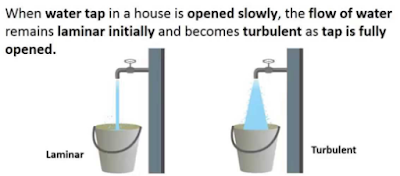
Reynolds Number: Reynolds Number is the ratio of Inertial forces to the Viscous forces. By knowing this number, one can describe the flow whether the flow is laminar, turbulent or transitional flow. There are three possibilities of the range of Reynolds Number: If Reynolds number < 2100 or 2300 ⟺ Laminar Flow If Reynolds number > 4000 ⟺ Turbulent Flow If 2300 < Reynolds number < 4000 ⟺ Transitional Flow In case of different shapes other than circle, the formula for Reynolds Number remain the same however diameter involves in the formula become Hydraulic Diameter which is given by: For pipe: Critical Reynolds Number ⟾ The Reynolds number at which the flow becomes turbulent Re cr For different shapes, the hydraulic diameters are given by: Completely Filled Flow In Closed Channel: If pipe is is considered to filled completely with closed channel, then following are the conditions which...
View Factor Orientation (or View factor or shape factor) plays an important role in radiation heat transfer. View factor is defined as, "fraction of radiation leaving surface 'i' and strike 'j' ". Summation Rule (View Factor) If there is are similar surfaces 'i' and 'j' , then: Blackbody Radiation Exchange Radiation Exchange between Opaque, Diffuse, Gray surfaces in an Enclosure 1. Opaque 2. Surfaces 3. Two surface enclosure Radiation Shield It is used to protect surfaces from radiation act like a reflective surface. References: Material from Class Lectures + Book named Fundamentals of Heat and Mass Transfer by Theodore L. Bergman + My knowledge. Photoshoped pics are developed. Some pics and GIF from Google. Videos from YouTube ( Engineering Sights ).
Mechanical Injection System: Used to inject fuel into the combustion chamber. Fuel speed > air speed at delivery point to atomize fuel. Amount of fuel delivered into the air stream going into the engine is controlled by pump which forces the fuel under pressure. A device used to initiate and control the combustion process is called Mechanical Injection System. Functional Requirements of Injection System: Metering of Fuel: Used to control fuel to meet speed and load requirements of the engine. Injection Timing: Have proper injection timing to obtain max. power, fuel economy and proper burning. It is done by Camshaft or Push rod (Rocker Arm) Mechanism . Proper Control of Injection Rate: To get desired heat release pattern during combustion. Proper Atomization of Fuel: Proper making of droplets to make best Air/Fuel mixture. Proper Spray Pattern: Distribution of droplets to ensure rapid mixing of fuel & air. Uniform Distribut...



Comments
Post a Comment
HI, we wI'll contact you later